Background
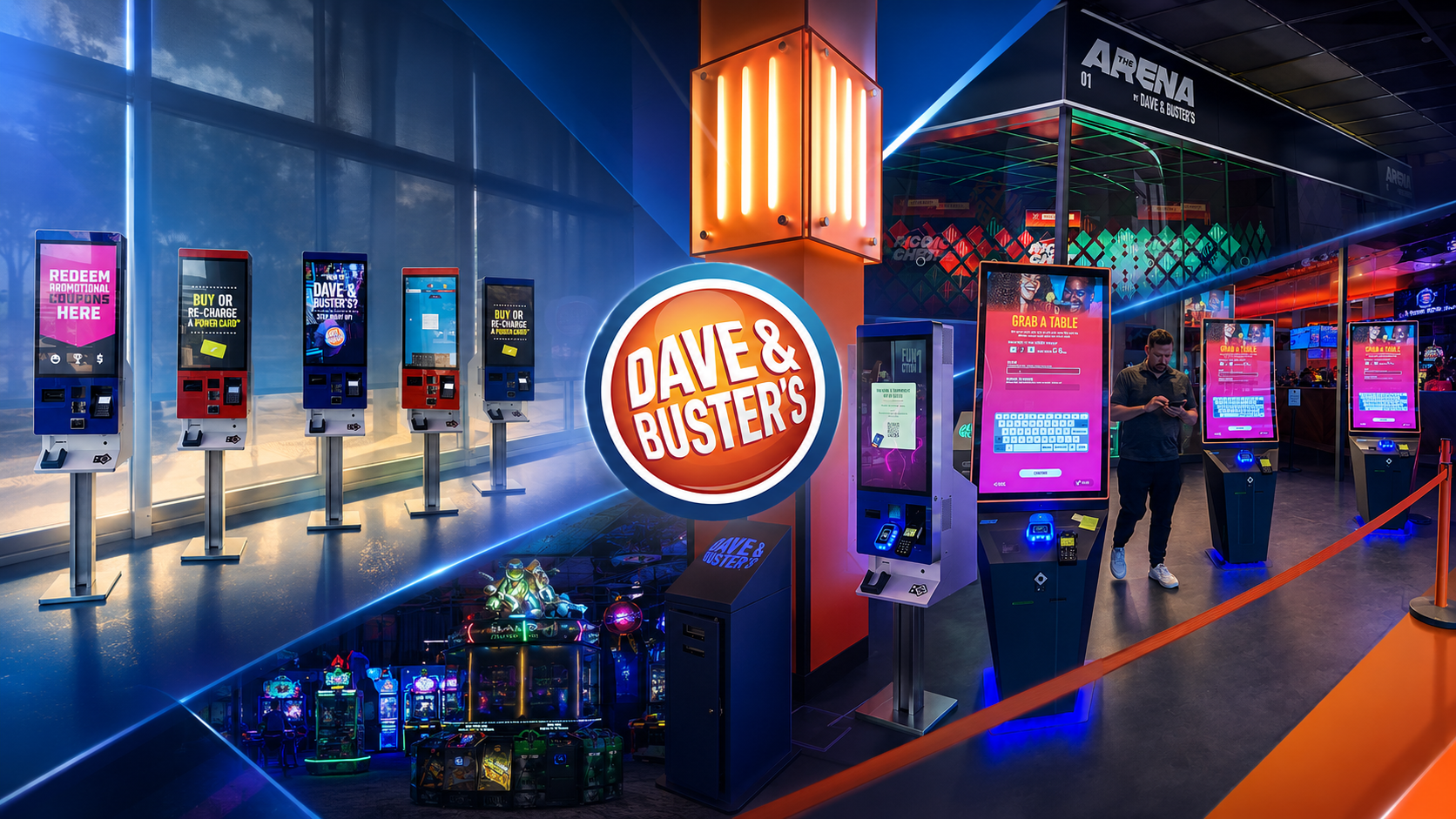
Dave & Buster’s operates a high-energy entertainment environment where guests expect to move quickly between eating, drinking, gaming and entertainment. Self-service kiosks became an important part of that experience, allowing customers to buy or recharge Power Cards, order food and beverages, purchase promotions and complete other transactions without leaving the action for long.
The initial modernization replaced aging order-and-payment technology with large-format multi-touch kiosks. The program began as a pilot and expanded after strong customer adoption and operating results, ultimately becoming a fleet-wide deployment. Diebold Nixdorf reported that the kiosks reduced queues, improved transaction efficiency and contributed to increased guest spending.
Behind the visible kiosk experience, Visionmax designed and built the software platform required to operate this channel at enterprise scale.
The Challenge
The challenge was significantly larger than building a touchscreen application.
Dave & Buster’s needed one kiosk platform that could operate reliably across a geographically distributed estate, connect to a wide variety of enterprise systems, support changing payment and promotional requirements, and continue evolving as hardware changed.
The solution needed to support:
- Power Card purchases, activation and game-credit loading.
- Food and beverage ordering.
- Dining Reservations
- Loyalty program registration, capture points and check balances
- Loyalty rewards programs and special contests for game play leaderboards
- Season Passes, coupons, gift cards, specialty credits and Eat & Play combinations.
- Multiple credit-card processors, including different providers by country and provider changes over time.
- Chip-and-PIN payment.
- Mobile tap payment.
- Cash acceptance through two different cash-machine interfaces on designated kiosks.
- Oracle POS integration for financial processing, reconciliation and reporting.
- Enterprise cloud services and other Dave & Buster’s operational systems.
At the same time, the software had to operate across five generations/models of kiosk hardware—three Diebold Nixdorf models and two GNR models—without creating and maintaining five separate kiosk applications.
The kiosk hardware itself also introduced a wide range of optional peripherals, including:
- Printers.
- Barcode and QR-code scanners.
- Power Card dispensers.
- RFID/tap-card readers.
- Payment terminals.
- Showcase lighting.
- Door alarms.
- Motion detection.
- Streaming video.
- Help/FAQ functionality.
The goal was therefore not simply self-service. It was to create a centrally operated enterprise software platform capable of making different kiosk configurations behave as one consistent business channel.
The Solution
Visionmax designed and developed the complete kiosk software stack used to operate the Dave & Buster’s self-service environment.
At its core is a single parameter-driven kiosk application that runs across all five supported kiosk models. Hardware differences, peripherals, country-specific payment requirements and store configurations are controlled through configuration rather than separate application code bases.
This allows Dave & Buster’s to evolve hardware while preserving one centrally managed software platform.
Kiosk Application
The customer-facing application manages the complete touchscreen experience, including navigation, purchasing, Power Card transactions, promotions, ordering, payment and customer assistance.
The application dynamically adapts to the capabilities of each kiosk, enabling or disabling functionality based on configured peripherals and store requirements.
Kiosk Daemon and Enterprise Integration
Visionmax developed a local integration daemon that operates behind the user interface and acts as the kiosk’s connection to the wider enterprise environment.
The daemon coordinates communication with systems including:
- Oracle POS and financial systems.
- Power Card gaming infrastructure.
- Enterprise promotion and coupon services.
- Gift-card services.
- Loyalty serivces.
- Dining reservation services.
- Season Pass systems.
- Specialty-credit programs.
- Eat & Play offers.
- Payment devices and processors.
- Cash-handling hardware.
- Local kiosk peripherals.
- Visionmax cloud services.
This architecture isolates hardware and enterprise integration complexity from the customer-facing application and enables new integrations or peripheral changes without rebuilding the entire kiosk experience.
Kiosk Lockdown and Device Control
Visionmax also developed the kiosk lockdown environment required to turn standard Windows-based hardware into a controlled self-service appliance.
The platform manages kiosk access, application startup and recovery, device behavior, administrative access and other controls required to prevent customers from accessing the underlying operating system.
Central Cloud Management
The kiosk estate is managed through centralized Visionmax cloud services.
Administrative tools allow authorized operations and support teams to:
- Monitor kiosk state and availability.
- Refresh kiosk applications remotely.
- Restart or recover applications.
- Push software and configuration updates.
- Deploy updated daemon components across large groups of kiosks.
- Perform remote testing and diagnostics.
- Review kiosk and transaction logs.
- Enable enhanced debug logging when investigating problems.
- Manage environment and rollout settings.
- Coordinate updates according to store time zones.
The result is the ability to manage a distributed kiosk fleet from a central platform rather than treating every kiosk as an independent PC.
Controlled Software Deployment
The platform maintains multiple software environments to support staged releases and controlled upgrades.
New versions can be introduced progressively while a known-good fallback environment remains available. This reduces deployment risk and allows the kiosk estate to remain operational while new functionality is introduced.
The production environment has been engineered around extremely high availability, with Visionmax operating processes targeting approximately 99.995% application availability.
Transaction and Behavioral Analytics
Every kiosk session also produces detailed operational data.
Visionmax captures:
- Session-level clickstream activity.
- Every screen and selection made by the customer.
- Timing between selections.
- Transaction outcomes.
- Payment activity.
- Kiosk status.
- Application and daemon events.
- Standard and diagnostic logging.
This creates a detailed operational picture of how customers use the kiosks and allows Visionmax and Dave & Buster’s to analyze usage, identify friction, troubleshoot issues and understand the performance of individual screens and customer journeys.
The Results
The kiosk platform has evolved into a major Dave & Buster’s customer-engagement and revenue channel.
Today, the Visionmax software platform supports more than 1,200 kiosks across three countries and processes hundreds of $millions in transactions annually.
Key outcomes include:
- One software platform across five kiosk models. Hardware has changed repeatedly without requiring separate kiosk applications.
- Centralized software operations across a geographically distributed store estate.
- Remote application and daemon deployment, reducing the need for on-site software intervention.
- Integration with core enterprise systems for payments, Power Cards, POS, promotions, passes, credits and ordering.
- Multiple payment and cash configurations supported from the same software architecture.
- 24/7/365 operational support across a footprint extending from Boston to Hawaii, Puerto Rico to Toronto.
- Detailed clickstream and transaction analytics for every kiosk session.
- Staged deployments and fallback environments that reduce upgrade risk and support extremely high availability.
- A platform designed to evolve, allowing new peripherals, payment technologies, customer journeys and kiosk hardware to be introduced without starting over.
The business impact is equally important. Diebold Nixdorf’s published case study reported reduced lines, improved throughput and increased spending as customers adopted the modernized self-service experience.
For Dave & Buster’s, the kiosk has become much more than a payment terminal. It is a centrally managed enterprise commerce channel designed to complete complex transactions quickly and return guests to what they came for—the experience.
Partner Responsibilities
The program combines specialized technology partners.
Visionmax is responsible for the kiosk software platform, including the customer application, kiosk daemon, lockdown environment, enterprise integrations, cloud services, remote software management, monitoring, analytics and software support.
Diebold Nixdorf originally provided kiosk hardware, installation, field/on-site services and first-level support. Its published case study also describes remote monitoring and software-upgrade services associated with the overall kiosk deployment.
GNR subsequently became a kiosk hardware and field-services partner, with the Visionmax software platform now operating on two additional GNR kiosk models.
That separation of responsibilities has allowed the hardware estate to evolve while the core Visionmax software and integration platform remains consistent.